 Juho
Juho

Hiragana is one of the systems for writing Japanese along with katakana and kanji. (More in Wikipedia) The hiragana characters are syllables and are generally always pronounced the same way. The system is very logical - What You See Is How You Pronounce It (WYSIHYPI). This logic also applies to alphabetic transliteration. However there are some exceptions and one of these exceptions inspired me to design a new character. The hiragana character "M".
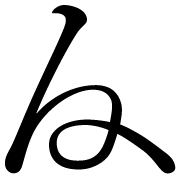
The hiragana set consists of five vowels, 39 distinct consonant-vowel unions and one consonant - N. There are some cases where the "N" is actually pronounced as "M" and the transliteration of it is "M".
Let's take a look at "Namba" (なんば 難波) which is the name of an area in central Osaka. It is written using three syllables - Na + N + Ba. However the middle syllable is pronounced as "M". When transliterated it also turns in to "M". One can argue the change is caused by the bilabial consonant B following the N and therefore a new character is not needed. I wanted to create a new character to address this exception from a graphical and typographical perspective. This is an experiment and a fun project that I wanted to do out of love for typography.
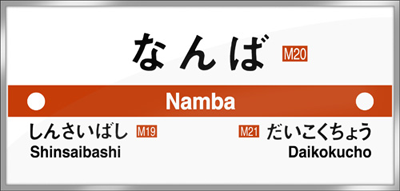
On the left we have the station sign for Namba located on the Midosuji line in Osaka in its current form. It is ideal for demonstrating a case where N turns into M. From a typographical point this is a perfect example too as it is often written in Hiragana instead of Kanji. People often think it is too difficult to write using Kanji!
Like the sign shows, the alfabetic transliteration has an M in it. Also the Japanese pronunciation has a strong M in it. However in the hiragana version it is an N.
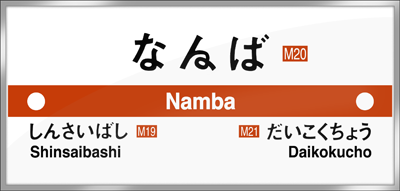
On right side we have the same sign with the M character added. The N in Shinsaibashi does not change as it is pronounced as N.
My design is derived from the hiragana N because it felt natural to use it as a base. Rather than just putting dakuten dots (゛) on it like in "Ka" か → "Ga" が I still wanted to give it a slightly different shape.
Besides working well with native Japanese words, a katakana counterpart would be useful when writing non-japanese names and borrowed words. For example in the case of "chewing gum" - which in Japanese becomes "gamu" (ガム) - pronunciation "gam" would still fit inside the range of natural Japanese phonetics.
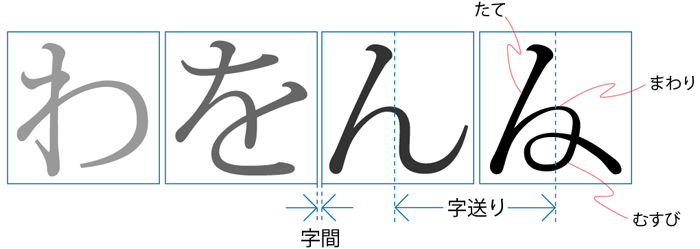
Anatomy and spacing of the character are shown above. Hiragana M consists of "tate" (たて), "mawari" (まわり) and "musubi" (むすび) elements. These occur commonly in hiragana.
The Unicode hiragana block has unused slots at code points U+3040, U+3097 and U+3098. Therefore it is technically possible to add more characters. However one would first have to overcome a few other hurdles. It is not impossible thought. For example the hiragana character yori ゟ was added to Unicode in the early 2000's.
This character is a graphical and typographical study and a fun experimental project.
-Juho Viitasalo-
Published: 2009.08.25 Last update: 2021.10.28